Exactly ten years ago my firm began designing our first Passive House. I had taken Passive House training in 2008 and at that time only a handful had been built. I knew that the only way to develop local interest in the approach was to actually build one. Luckily for me, Brendan O’Neill, a builder I have worked with for over 25 years, was game to do that, on spec, on a lot he owned. His only requirement: that it fit into a neighborhood of traditional houses and that it sell! We made it our challenge to show that a Passive House can be indistinguishable from a standard house.

The house has a building envelope that is essentially airtight, with about twice the insulation of a standard house. It uses small high efficiency heat pumps and energy recovery ventilators in two separate zones. Except for the mechanical room, and the thicker walls, nothing gives it away as a passive house.
I would say that we learned about 80% of what we know now from the construction of that first house. Subsequent houses have built upon that knowledge, and continued to teach us new lessons.


The traditional passive on the left was completed in 2013, the modular passive on the right in 2015.

This passive retrofit of the historic carriage house above was completed in 2017.
Our biggest surprise in building these houses was that while clients loved the low energy bills, they loved even more the quiet, the comfort and the health benefits these houses provided.
All these houses were designed in the context of an antiquated, top-down energy grid. Due to cost, onsite solar generation and storage were unavailable. The Passive House approach, with its emphasis on building efficiency, enabled us to make the most of a terribly inefficient energy system.
When I say inefficient, this is what I mean.
With this pie chart let’s look at the path of energy from a lump of coal to powering your I-phone or your refrigerator.
 First coal is extracted and shipped to central plants, requiring about 5% of the energy the coal can produce.
- 63% of its energy is then lost in centralized power plants.
- 1% is lost as it is transmitted long distances over high voltage power lines.
- 2% is lost as it is stepped down in transformers to power lines that take it to your house.
- Finally 3% is lost as it is converted from alternating current to the direct current that powers your I-phone and your refrigerator, leaving you with a mere 26% of the energy from the original lump of coal as usable power. The rest has become carbon dioxide and heat.
But that picture is changing. Solar costs have plummeted 75% and will continue to fall. In many areas they are already at parity with fossil fuels. Solar and wind are now the first or second choice in developing new large scale power installations. Annual solar system installations have increased by a factor of nearly 40 in these last ten years. Energy storage is following the same S-curve of disruption, with lithium-ion battery prices now ¼ of what they were just 7 years ago.

These disruptions are driving changes to the architecture of the grid. We have already moved from the traditional grid shown at the left to the bi-directional grid shown in the middle. With net-metering, consumers can now sell back power to the utilities and, with enough solar production, can become net zero on an annual basis.
But the change is now underway to create completely new grid architecture – a distributed grid, shown on the right:
- A grid where building owners can generate and sell power to utilities and to their neighbors,
- A grid where power can stay local in community and neighborhood microgrids and avoid long distance transmission losses
- A grid where consumers are also producers, guaranteeing grid reliability when the grid is down
- A grid where the utility company becomes primarily the transmitter of energy from large-scale energy suppliers (wind farms, large scale solar arrays, and the like) as well as from the rooftops of houses. The utility is no longer the sole generator of energy.

To imagine this new grid, think of your house as a cell in a larger organism. It is connected to its neighborhood microgrid, which is connected to its community microgrid, and that to the larger grid. Each unit is in constant communication with the other systems, but each can stand alone and isolate itself from the larger system if that system is attacked or breaks.
A distributed grid is not fantasy. It is being driven by a number of factors:*
- From a national security perspective, politicians on both sides of the aisle are for it because it offers resilience against cyber attacks and terrorism, as well as against natural and weaponized electromagnetic pulses, called EMP’s.
- From a decarbonization standpoint, Green New Deal politicians are for it because it provides the path to a de-carbonized grid.
- Local politicians are for it because they have seen what happens to communities in the paths of fires and hurricanes, and want resilient local power that is available even when the main grid goes down.
- And finally, economics is driving it because it is incredibly expensive to buttress a failing 19th Century infrastructure. So much so that across Africa and Asia countries are bypassing centralized power grids entirely, in the same way they bypassed building extensive telephone infrastructures and went directly to cellular systems. They are generating power locally, and distributing it in community microgrids that will eventually be linked across the continents.
All the technology exists for a distributed grid. What stands in the way are two things: the incentive structure of the utility monopolies that control the grid, and peoples’ natural resistance to change.
But the changes are inevitable and are happening now. California and New York, two progressive states that have directly experienced catastrophic climatic events, are leading the way. They are funding decentralized energy generation, working on ways to incentivize utilities through performance rather than through creation of additional power plants, and working with communities to develop local microgrids for energy generation. Microgrid projects now exist in homes, at university campuses, in critical facilities, and in neighborhoods. Even Alcatraz has a microgrid with local generation.
So what happens to the energy pie chart when we go from the old grid to the new grid?

Now, 81% of the power generated locally get’s to your Iphone or your refrigerator.
- 4% is lost, as before in neighborhood transmission lines
- 5% is lost from inverting the direct current coming from the solar panels to alternating current that runs through your house and on local transmission lines.
- And anywhere from 3% to 25%, depending on the device, is lost in converting back from alternating current to direct current to power your devices.

All the equipment shown in this picture is powered by dc current. That is about 60-70% of your household electrical demand. This is not readily obvious because most of these things have built-in transformers to convert AC to DC. Think of the wall wart you plug your phone into to charge its dc battery. Really the only things that require alternating current today are resistance heaters and outdated appliances. Alternating current should be the exception rather than the rule.
So what if we eliminate all those conversions and transmit power as direct current, as Edison proposed 100 years ago. We couldn’t do it then because the slid state equipment necessary for that had not been invented. But we have all the tools needed to do it now. Then the pie looks like this:
There are now only two losses: local transmission, and losses associated with stepping direct current power up and down as required by its different uses, leaving 91% of locally generated energy available.
Blockchain will enable peer-to-peer energy trading. Just as it is now transforming data protection, banking and other aspects of the economy, it will facilitate the new distributed energy economy.
Buildings will be key players in this new economy. If they are built efficiently they can become energy generators as well as consumers. An average building, represented by the box on the left below, requires about 54% of its gross floor area for solar panels in order to meet its energy needs. The Passive building represented on the right requires only 17%.

This means that the one story building on the left has only about 45% of its roof area available to generate exportable energy, while the Passive building on the right has over 80% of its roof still available to generate exportable energy.
 It also means you can create greater density with Passive construction. The solar roof area of the average construction building on the left below can only provide energy for 1-1/2 stories, while the Passive building on the right can provide energy for five stories. As solar and battery prices continue to fall, potential for onsite solar will affect mortgage payments and the bottom line of the cost of ownership of your home or office building.

It is these kinds of calculations we have had in mind in our latest Passive projects.

The Fairfax Net Zero house, completed in 2017, has a 19.7 kW solar array on the roof, designed to power the house, a hot tub, and an electric vehicles. It has additional space on its garage roof to power a future second EV.
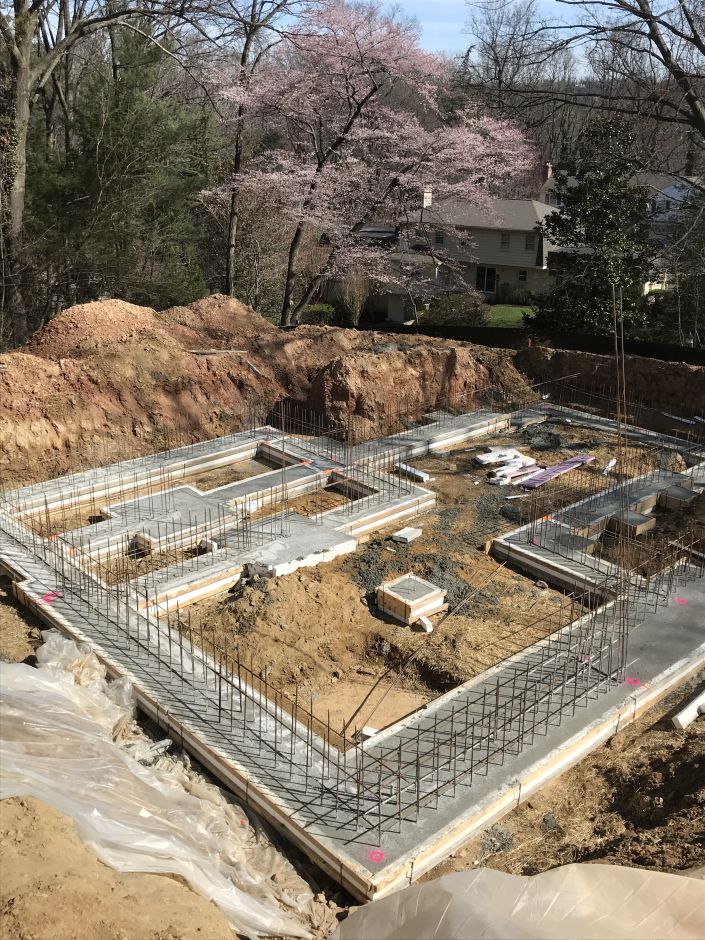
With the Arlington Net Zero Passive House, currently under construction, our goal was to create another Passive net zero home. But we had a second goal: to create a true hybrid ac-dc microgrid – a house that provides direct current to all its native direct current loads, generates its own power, stores it, and trades it with the grid. Craig Burton and Tom Voltaggio of Interface Engineering, who designed the electrical system at the zero energy American Geophysical Union, have been our partners in this effort.

Unfortunately no residential power management system yet exists to create a hybrid microgrid. Nor are there next-generation direct current lines of lighting fixtures, appliances and mechanical equipment on the market at this point. So, anticipating this house will be here for 50 or 100 years, our goal has become making the house as future-ready as possible. In this case, here is what future-ready means:
- The house, now halfway complete, will be a completely islandable microgrid– meaning it can function independently using its battery and its solar array when the grid is down. This is achieved through the use of the Storedge Inverter system + LG Chem RESU batteries and dedicated backup electrical panel.
- Power will go directly from a 10 kW solar array on its roof to a 10kW battery in direct current, without the normal DC to AC to DC inversions that occur in standard solar systems.
- It will be wired so that a future mobile 60kW battery (AKA: electric vehicle) can become part of the microgrid, at times taking power from the rooftop solar array, at other times giving power to the house during grid outages.
- It will be wired so that the next generation of residential lighting fixtures, appliances and mechanical equipment can be incorporated when they become commercially available in dc versions.
- It will have USB Type A/C combination receptacles throughout for convenience charging of electronic devices.
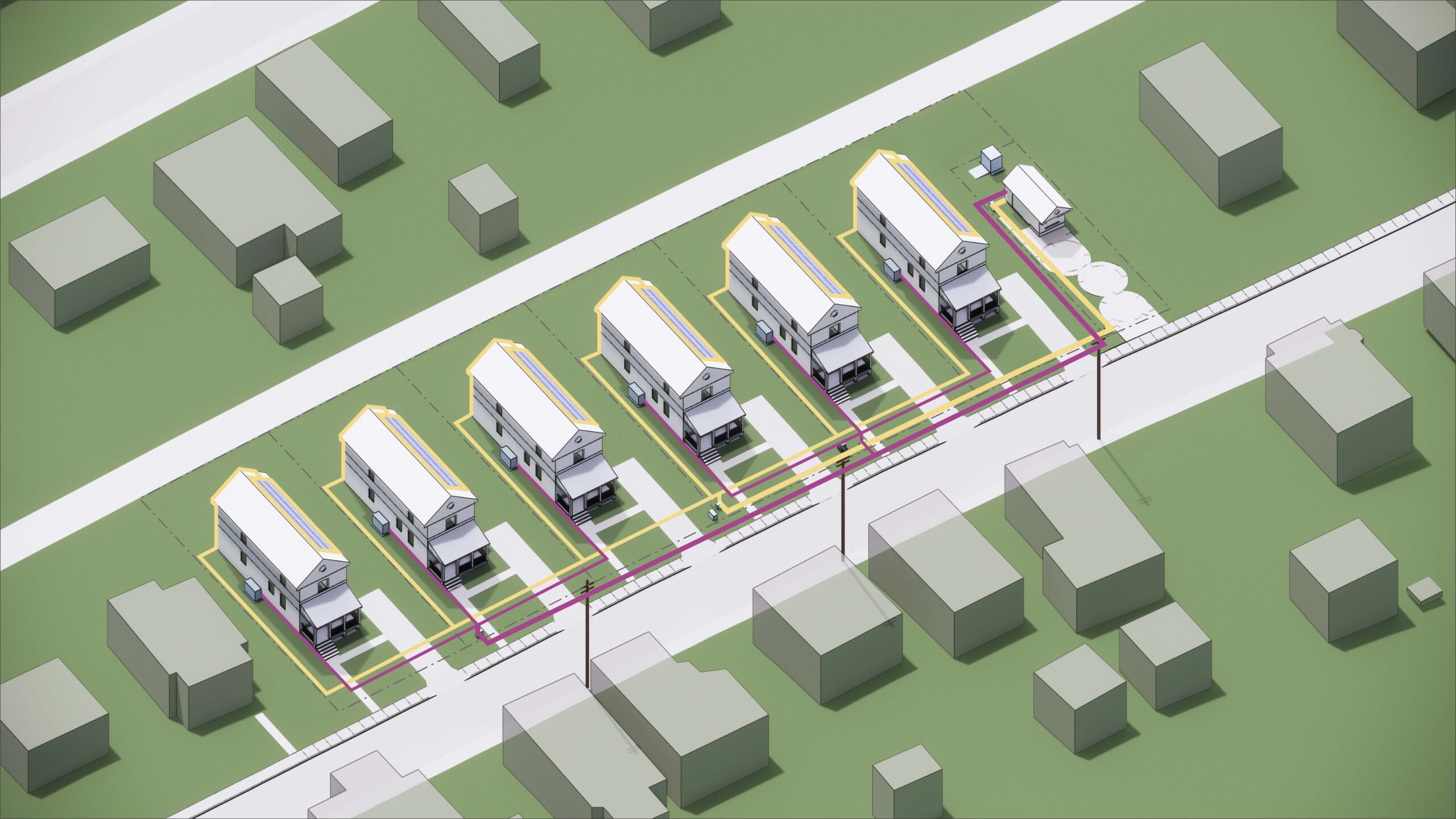
- And finally, it will have conduits running to both neighbors, in anticipation of a future neighborhood microgrid.
Completion is scheduled for July of next year. Follow the progress in future blogs.
*Many thanks to Terry Hill of the eMerge Alliance and PHIUS for educating us on the role of the coming transactional energy grid.






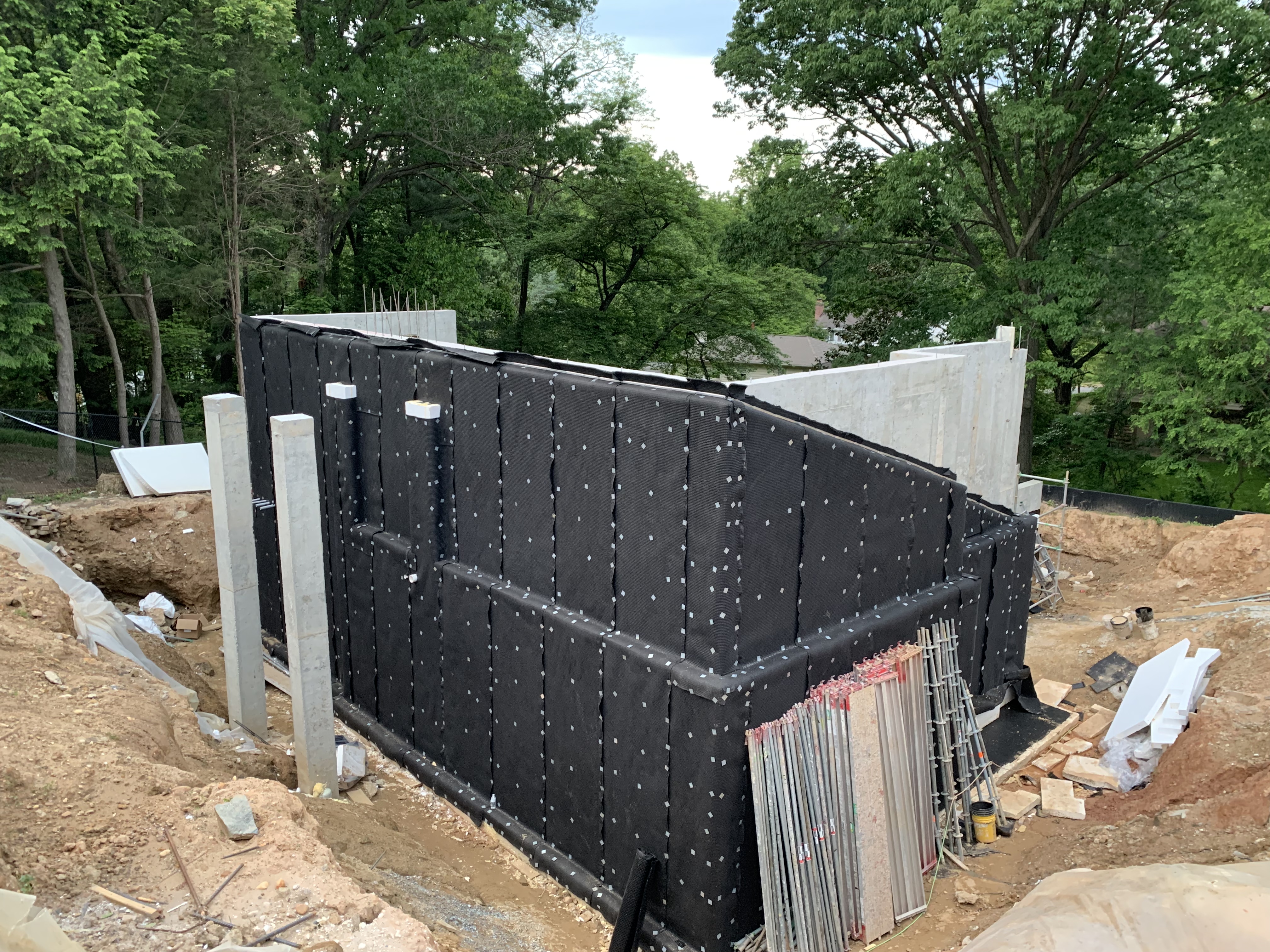

 View from the south east. Waterproofing starting to go on the walls.
 Torrential rains came just as they were about to pour the basement slab. Here you can see the 15 mil Stego vapor barrier (yellow with red tape at all joints) after the flooding. All the reinforcing and the vapor barrier had to be taken out and re-done because of the damage from the flooding and contamination with mud from the site.

 View to the east from basement.
 View from southwest from the street.
 View from the south.
 View from the south.
 The west wall before backfilling on a dry day. The two story concrete post will carry the entry terrace.
 Looking west at south wall.
 Then more torrential rain.