Blog

  • Work begins on our  newest Net Zero home

    Work begins on our newest Net Zero home

    Site work has begun on our newest net zero home. The builder is O’Neill Development, with whom we have worked on all of our Passive Houses. The first step was to de-construct the original house, in which the owners had lived for the past twenty years. De-construction is being completed this weekend by Deconstruction Services, LLC.. Their first step was to glean all the usable equipment from the house — doors, cabinets, fixtures, etc — which they donated to ReBuild Warehouse. Then they tackled all finishes that could be removed intact and re-purposed, the hardwood flooring, and all the framing lumber. All nails are taken out  in their shop; the wood is stacked and graded; and then it is given to Community Forklift to go into other homes.

    The next step is for Bartley Concrete, the concrete subcontractors, to demolish the brick walls left standing and all the existing concrete. These materials will all then be put in a dumpster and taken to a commercial recycling facility for sorting. They will end up as rubble for roadbeds and the like. In our last project, less than 8% of the house went to a landfill.


    View from street after deconstruction, before demolition.

    View from below after deconstruction, before demolition.
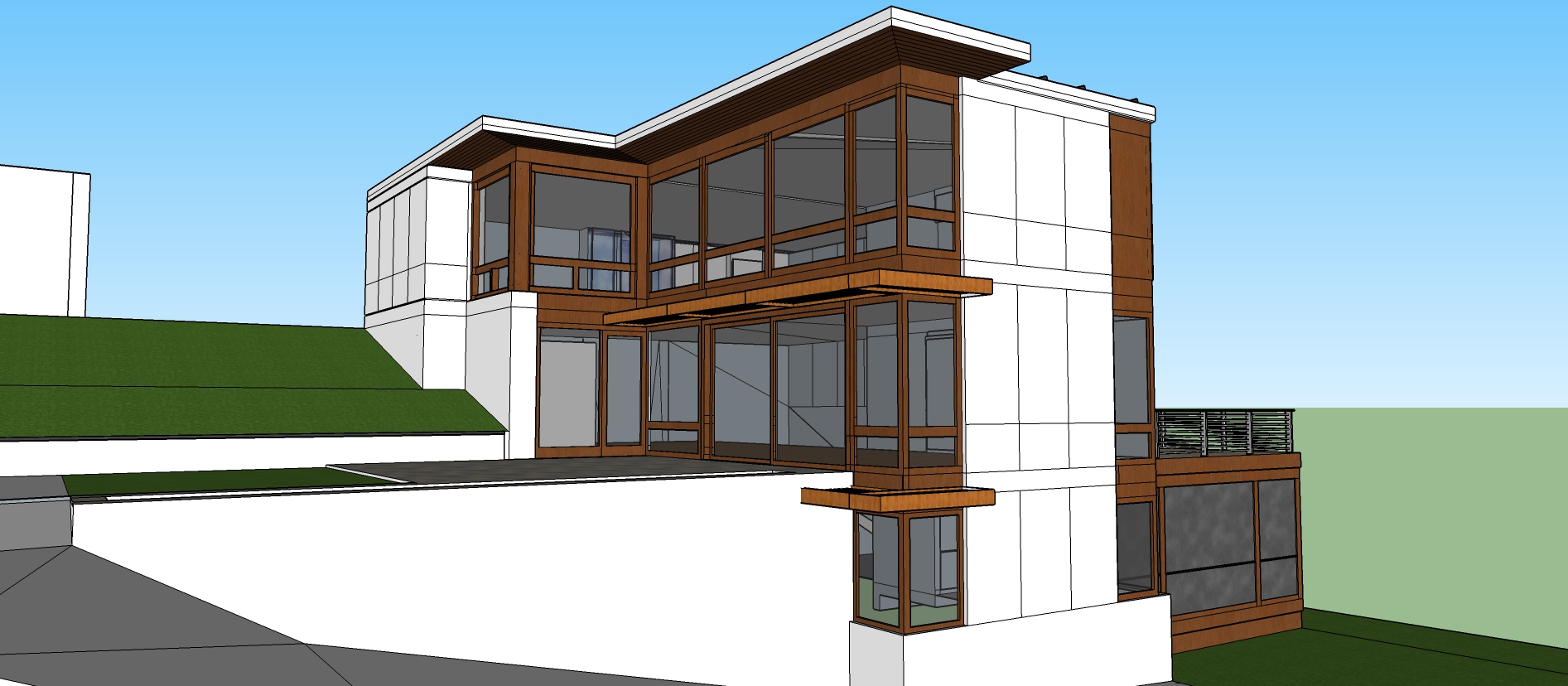
    New Net Zero Home in Arlington VA
    Rendering of the final design
  • Report from our Maine Deep Energy Retrofit


    My family just spent two weeks of Christmas vacation in the 1850 SF farmhouse we renovated last year. You can learn more about the renovation on that blog. Here is how it performed with a family of 5 plus a couple of extras beds filled from time to time:

    Heating:

    We heated exclusively with the new Moreso 7642 woodstove in the first floor kitchen. That puts out a maximum heat of 35 kBtu/hr once it’s fully fired up. On cold days (mid teens) with no sun we kept the stove going all the time, and temperatures stayed in the high 60’s. Adding more logs we could have pushed it into the low seventies. When there was sun, regardless of the outdoor temperature, the front (south) rooms of the house got into the mid seventies and we let the stove die down till late afternoon.

    What was most satisfying though was the lack of drafts and the even temperatures throughout the house, never varying more than a couple of degrees between attic and first floor spaces. I think the reason has as much to do with the continuous insulation as with the Zehnder HRV which we kept running at low speed distributing the air.

    Electrical and solar

    We also kept track of electrical use to get a sense of the demand that we will need to fulfill with the solar and battery package that we will be installing in March. With a houseful using the old electric washer and dryer, the old radiant electric heater in the un-restored bathroom, and doing a good bit of cooking and baking on the induction cooktop and electric oven, we burned through nearly 35 kWh/day. That would require an array producing 12,700 kWh/yr to achieve NZE on an annual basis.  I logged one 24 hour period, however, where we did not use the radiant bathroom heater (which is temporary) and the washer and dryer. The energy use plummeted to 15.8 kWh/day, or an annual demand of 5,775 kWh/yr. So once we disconnect the old electric heater and set up winter clotheslines in the basement to supplement summer clotheslines, we will be well under the 8,400 kWh/year anticipated from the array.


    Batteries

    The EnSync Energy matrix will come with two 9kWh Li-Ion batteries for an effective storage capacity of 18kWh. This would give us one day of full use, but as the only really critical loads are the water pump, the furnace switch, and the refrigerator, we should easily be able to go without power for a week in the winter, cooking on the woodstove and playing by ear how much we use the induction stove.

  • Harvard’s 9 Foundations of a Healthy Building

    Good reading here in the blog of Katrin Klingenberg (Passive House Institute -US Director)…

    http://blog.phius.org/healthy-buildings-part-1-9-principles/

  • Deep Energy Retrofit of a 19th Century Maine House

    This project is personal: the renovation of our family’s house in Maine. It is a work in progress. The goal has been to take care of a century of deferred maintenance and to make the house as energy-efficient as possible for year-round living. The great challenge has been to make all this work invisible, so that in the end it still looks like an old Maine house, not a renovation in the suburbs.

    The givens in that challenge were:

    • we would save the original exterior siding and trim;
    • we would save the original windows;
    • we would keep the kitchen as true as possible to the original;
    • we would keep or match all original interior doors and trim;
    • we would not change anything about the room configuration, except in the attic.

    We discovered some unpleasant surprises along the way:

    • rotted sills on the about two thirds of the perimeter of the house;
    • rotted siding and framing in the attic;
    • original 2×8 floor joists that spanned over thirty feet with no support;
    • a chimney that needed complete rebuilding; and
    • we had to replace the entire roof.

    UPGRADING THE BUILDING ENVELOPE TO 21st CENTURY STANDARDS
    One of the long term goals for the house is to make it island-able – that is, able to function independent of the power grid when necessary. The first line of attack in achieving this goal was to insulate and air-seal the house, which until this year was in its original un-insulated state.

     Siding
    In an ideal world we would have pulled off the siding and done the work from the exterior, installing insulation between the studs, rigid insulation and liquid applied air/water barrier outboard of the studs and sheathing, and a vented rainscreen behind new clapboard siding. The aesthetic/sentimental requirement to preserve the original exterior required us to explore ways we could safely insulate from the interior. The great concern here was not to recreate the kind of condensation problems that had ruined the attic (see below under Surprises). The first step was to remove the interior plaster, which after 120 years had served its useful life.

    We opened up the walls to find beautiful fir studs, essentially unchanged from the condition they were in 100 years ago.

    We filled the stud cavities with closed cell (vapor impermeable) foam sprayed tight to the exterior sheathing. While foams are not our first choice in most situations, in this case it was the only thing we knew that would guarantee no warm interior air would get through to the face of the sheathing. More on that below.


    We then placed 1” of rigid extruded polystyrene (XPS) insulation over the interior face of the studs to block thermal bridging[1] where foam insulation was interrupted by stud framing.

    Finally we covered the XPS with lath and drywall.

    This brought the interior wall surface about an inch further into the room than it had been before – a sacrifice we were willing to make given the extra thermal protection it gives us.

    There is risk in the approach we have taken. Water in heavy, windy rains typically gets behind wood siding. Our concern is that now that there will be no air moving through the walls, this water could get into the sheathing boards and sit there, causing them to deteriorate. Over the next few years we will monitor the moisture levels in the walls most exposed to the weather and see if this is a problem. If it is, we may have to do what we have tried to avoid and take down the existing siding and install a proper rainscreen, as described above.  Our thinking is that it would not be that much more difficult to do this later compared to doing it now, and hopefully we may not have to. An architect can take this kind of risk when he is the client!


    Roof
    The original roof framing was in good condition, but was built with 2×6 joists at 24” on center.
    Already way too light for the span, the added weight of insulation would have made it even more structurally unsound. We also had to consider the fact that the surface of an insulated roof would stay cold and thus would carry far more unmelted snow than the old un-insulated roof.  And from an insulation standpoint, 6” was hardly deep enough to provide a decent insulation cavity. So we decided to sister all the rafters with 2×10’s to give us the strength and depth required by codes today.

    Original joists with new sistered joists starting to go in.


    As we got into it, we found that the fitting the sisters to the deflecting existing framing was far more time-consuming than simply re-framing the roof. Since the old wood decking and shingles were coming off anyway, re-framing made sense.


    New 2×10’s and new chimney


    We filled the new roof framing cavities with a combination of 4” of closed cell spray foam and an additional 5-1/2” of fiberglass.


    New rafters with 4” of closed cell spray foam.


    Then we attached 1” expanded polystyrene (XPS) to the bottom face of the rafters to achieve a total insulation value of around R-54.  Not Passive House level, but pretty good.  


    Fiberglass and XPS cover 4” of foam

    Basement
    Another tricky challenge has been the basement. The original open water well for the house is located there, and obviously a source of moisture. The original stone foundation walls also leak badly in heavy rains . There is an interior perimeter drain that collects that water and carries it to a drain and to daylight in the lower front yard.

    We paid good money to building envelope consultant to help us with this and he pretty much threw up his hands and told us what we already knew: that there is no great solution short of filling in the well, rebuilding the walls and putting in a new floor. Not in the budget.  We considered the approach of completely encapsulating the floor and perimeter stone walls with heavy polyethylene and insulation, basically making the basement space a part of the house. But with all that poly the basement would be essentially unusable, not to mention the difficulty of making the polyethylene barrier completely vapor-tight around all the existing structure, wiring and piping. Nor did my wife want to lose the look of the original stone wall.

    The approach we decided upon is to insulate the first floor joists with open cell foam (removable if we need to get at a pipe or a conduit someday, unlike closed cell foams).  We will re-cover the well with a more airtight cover. This will isolate the basement thermally and deal with most of the moisture migration. But it means we will have to handle keeping the basement above freezing and dry by mechanical means. We are not doing this work at this stage, however, preferring to evaluate the house’s performance after a year.

    Windows
    Probably the toughest challenging to achieving an air-tight, well-insulated house was our desire to keep the original windows, whose wavy glass throws so much beauty on the walls when the sun is low in the sky and gives the house so much of its character. Had this not been a priority we would simply have removed the old units and used triple glazed European sash that we use on our Passive House projects.

    Instead, working with Sergei and Matt we came up with a several-pronged approach:

    • First we had all the existing sash re-glazed using the original glass. Where the old glass had already been replaced we did not try to match it with fake old glass. We fixed the upper sash in place and foamed the cavity they are in. We kept the lower sash operable, replaced the sash cords where necessary, and then sealed those cavities with caulking.
    • Since we needed to modify the interior trim anyway due to the now-thickened walls, we built in a little shoulder around the interior trim opening for removable lightweight gasketed glass panels made up in a local shop.
    • We are also making up removable glass panels that can be installed on the exterior, just as the original screens were. We will deal with moisture and condensation between the sashes with little trays of salt, as Sergei did at his “Pushkin house”. Voila: triple-glazed windows!

    We also replaced the badly deteriorated windows in the attic and added new windows to make a brighter stairwell. These are American-made Alpen high efficiency outswinging casement units (R-7) which have a profile closer to the original sash than the bulkier European triple glazed units.

    Finally, we added two operable Velux roof windows in the attic to give additional ventilation and light.

    Ventilation
    With the house as tight as we are making it with the new insulation and upgraded windows, keeping good indoor air quality when the house is buttoned up in the winter becomes important. To deal with this we installed a Zehnder energy recovery ventilator. Basically this uses a very efficient small fan to exchange fresh outdoor air for stale indoor air. The two air streams slowly pass by each other in a matrix of small vapor-permeable tubes wherein around 90% of the heat and 50% of the humidity in the outgoing air is transferred to the incoming air. It removes the stale air from the bath and kitchen areas and distributes the fresh air in all the bedroom and living spaces at an imperceptible velocity (15/cfm).

    ERV unit and ducts under the east gable.

    Energy
    With energy demand cut as much as possible, the next phase of the project is energy supply. Hopefully the new high efficiency Morso wood stove will provide most of the heat we need. We plan to continue using the existing oil-fired boiler and radiators as a supplement and replace the boiler when it dies with one that is wood-fired.

    We are working with Revision Energy on a plan for an 8kw pv array on the roof. While we initially assumed the roof was not suitable due to its predominantly east and west facing slopes, we have learned from them that the loss in efficiency is between 20-25% — an acceptable trade-off when the only other option is a ground mounted system which would require clearing a significant amount of woods.

    We will be using EnSync’s Home Energy System inverter with a 1okWh lithion ion battery. This is a hybrid ac-dc energy system that will connect rooftop panels directly to battery storage without having to be converted from dc to ac and back to dc. It will allow living completely disconnected from the grid during power outages. Our larger goal is to make the house as future-proof as possible as the world moves toward a direct current transactive energy economy. For more on this subject, see our earlier blog And read below under Future-proofing.

    SURPRISES
    #1  Sills
    Even though we found no evidence from an initial inspection the exterior, we discovered once we got into construction that many of the original chestnut sills were badly deteriorated. After scratching our heads on how could we affordably jack the house and replace the old sills, we learned that Will, our electrician, has an interest in old structures and had invented a metal rig to make this job far easier than anything we were considering. He generously loaned this to us for the project and the replacement work was not nearly so involved as we had feared.


    Deteriorated sill above. New sill going in below. Note Will’s jacking device.


    #2  Attic gable walls
    In 1996, right after we bought the house, we insulated and refinished the attic into two bedrooms for overflow space for the children. Following best practices of the time, we stuffed the joist cavities with fiberglass batt insulation and called it a day. It was an expensive lesson in building science. When we opened up the walls we found that the studs and the sheathing were completely rotted and that the paint on the exterior and the drywall on the interior were basically all that held the walls in place.


    Here is what happened: in wintertime the warmest, most humid air found its way to the attic. As it escaped through the walls through gaps in the insulation the moisture in the air condensed on the cold interior face of the exterior sheathing, just like water forming on a can of beer. The insulation then acted as a sponge and held the water, causing the rot. In the rest of the house, where walls were completely uninsulated, condensation had occurred as well, but immediately dried as air moved through the wall. This is the reason that in this climate it is essential to prevent any vapor from contacting a cold surface—something foam insulations are very good at.

    #3  Strange framing practices
    As we took down the crumbling interior plaster we discovered that one of the reasons for cracks upstairs was that some of the original 2×6  second floor fir joists spanned 26’—double what code would allow today. We inserted a heavy wood beam in the kitchen to cut that span in half. If you look, you can see that the kitchen ceiling is now furred down by about 3″ to hide the new LVL beam, which is upset in the joists.

    #4  Deteriorated chimney
    Shortly after buying the house we had the original brick flue checked and found it leaky. We had it lined with a lightweight concrete system that is designed for retrofitting chimneys that have no flue liners. We did not realize that there is a life-expectancy for these retrofits. We learned this this winter that ours was definitely past. We had to take down the original chimney and rebuild it from the basement up. We used an old photograph of the house to match the original height and cap profile, which had been lost over the years.

    INTERIOR CHANGES
    American Clay
    We loved the old plaster walls and hated the idea of replacing them with modern sheetrock. Sergei told us about the American Clay wall finsh system, which he had used on another project recently. We saw some samples and decided that would be a reasonable compromise from re-plastering the whole house. We did the first floor living and dining rooms and the bedrooms upstairs with the American Clay product. American Clay also claims valuable health benefits: the clay releases negative ions into the air which combat the EMF effects of computers and eliminate static electricity. This apparently significantly improves the indoor air quality for people with allergies to pollen and pet dander. With our pets Wally and Mimi as residents, we will see if that proves true.

     Kitchen
    In removing deteriorated interior plaster we had to completely take apart the original beaded board kitchen cabinets. We put them back as close to the original configuration as possible, and were able to save most of them, at the same time incorporating a new sink and appliances. We did agree to replace the formica countertop with local slate. The floors were badly deteriorated linoleum over plywood. We took all that up and put down new fir floors.

    The old kitchen.

     Attic
    The one area that wasn’t considered sacrosanct was the attic. Here we exposed the new brick  chimney and opened it up into one big flexible skylit space with a built-in bunk and cabinets tucked in the low spaces.

    The area of the house that was not touched was the lean-to on the back containing the bathroom, which we re-did in 1996. We chose to save this for a later project.

    FUTURE-PROOFING
    Getting ready for direct current microgrids

    If predictions of current trends in energy are correct, ten years from now we will be living with a distributed energy grid, where neighborhoods and communities generate their energy locally and buy and sell energy to the power grid. Because power is generated and stored as direct  (not alternating) current, and because most loads in our homes are natively direct current (think all high performance mechanical equipment, pumps, electronics, and lighting), the US will be moving more and more toward a direct current energy platform. This is already happening in the Third World, which is not burdened by an outdated energy grid infrastructure. Cost will drive this, because every time you convert energy from ac to dc or back, you lose energy (and money) in the form of heat. It’s why the wall wart for you IPhone gets hot.

    Part of the reason for installing EnSync’s Home Energy System is to make the house ready for that new energy reality. Our new wiring has individual circuits to appliances, motors, lights, outlets, etc. So when, for example, direct current refrigerators come on the market, we can switch over the refrigerator circuit from the AC to the DC side of the inverter and it will be supplied direct current through the same wiring. Energy savings can be between 7% and 15% for each time energy is converted.  When you think that photovoltaic  energy that gets stored in a battery in your house and then used by a modern refrigerator is inverted four times, the numbers start to matter. Some say savings in dc net zero homes could be as much as 30% over ac homes.

    EMF’s
    The other electrical change we have made is more about health than future-proofing. More and more is coming out about electromagnetic fields’ (EMF’s) association with cancer and other health issues. Sleeping next to a floor outlet or light fixture exposes you to significant EMF radiation even when nothing is turned on. As a safeguard, we have placed a master switch in each bedroom that controls all floor outlets and lights so that when we are sleeping we will be in an EMF free environment. Interestingly, there are no EMF issues with direct current wiring.

    The Team
    General Contractor:                         Sergei Breus, Inc.
    Lead Carpenter:                               Matt Jordan
    Lead Millwork Carpenter:                Joe Hermans
    Carpenters:                                      Andrew Monk and John Warfel

    Subcontractors

    Excavator:                                        Jim Gross
    Mason:                                              Dennis King, Dennis King Masonry
    Insulators:                                         Pete Anselmo,Builders’ Installed Products
    Drywall:                                             Keith Fitzgerald, Drywall Connections
    American Clay:                                 Mike and Kollin Krinkert
    Kitchen Cabinetry:                           Jeff Schaller
    Plumbing:                                         Jason Perkins
    Electrical:                                          Will Lounsberry, Will Power

    Consultants:

    Structural Engineer:                         (Another) Jim Gross
    Help with colors:                               Jean Kee, The Painted Room

    It is misleading to call Sergei’s team carpenters. They do demo, they jack houses; they paint; they install ERV’s (Sergei is a licensed ERV commissioner); they do whatever it takes!

    ________________________________

    [1] A thermal bridge is a short-circuit in the insulation envelope of a building, where heat can escape. Every wood framing member in the building envelope is a break in the insulation blanket and a potential thermal bridge, unless it is covered with insulation.
  • A proposed microgrid community of modular net zero homes

    This YouTube video is a presentation we just did for a community development group in Virginia interested in developing a new neighborhood of high performance net zero energy homes. Our concept is based upon using a combination of several basic modular designs to create both single family homes and duplexes. We show them with both contemporary and traditional appearances.

    The construction approach is based upon the prototype modular Passive House we completed with Housing Initiatives Partnership in 2015.

    The video begins moving down the existing street, which has existing concrete affordable housing units on the right as you drive down it. We make a U-turn at the end of the street and begin back up the sidewalk, passing two existing modern houses sandwiched in with our new single family modular homes. We then go down the new street, passing a mixture of contemporary and traditional modular duplexes. Coming back up that street we pass the day care/ training center, proposed as a cross-laminated timber structure, and then duck down the back alley to see the community garden and solar array for the community microgrid in the background.


  • The Microbiome and Your Home

    I have been reading recently of developments in the study of the human microbiome and its interconnection with the larger environment.  It is changing my thinking about how we should be building our houses (and hospitals!). A microbiome is basically the collection of organisms that inhabit a particular environment, be that the intestine or a field of daisies. It turns out that that the interaction between different microbiomes is far more dynamic that we ever imagined. It confirms scientifically that it is an illusion that we are separate from the environment in which we live; it is part of us and we are part of it.

    For the last fifty years we have seen bacteria and viruses (billions of which make up the microbiome) as the enemy, and we have been at war with them on every front – at the macro scale with millions of tons/year of glyphosphate (Roundup, for example, which is actually patented as an antibiotic not a pesticide) dumped into the environment, and at the micro scale with antibiotics pumped into livestock and humans at alarmingly increasing rates.  We have been killing life wherever we meet it. We are now learning that the chronic health issues we face today, particularly autoimmune diseases, are all collateral damage of that war. We are learning that we co-inhabit the world with these organisms and they are essential to our own life.

    So what does this mean for our homes? The evidence is overwhelming that buildings that get poor fresh air ventilation of can be toxic. Legionnaire’s disease and Sick Building Syndrome are life-threatening. The energy recovery ventilation systems that we provide in all our houses address this issue; even though these houses are airtight, they have plenty of fresh air at all times. Similarly, our approach to building envelope design eliminates condensation and takes away the issue of toxic mold growth getting into the building microbiome.

    But is this enough? We know plenty about what makes an unhealthy building microbiome, but so little about what makes a healthy one. Do the MIRV13 filters in our ERV’s take out too much from our fresh air, for example? One study shows that exposure to dog-associated bacteria can be protective against airway allergens. Another shows that the more diverse the microbial environment, the lower the incidence of asthma. And here is a creepy one:

    “children exposed to specific types of bacteria… in common with well known allergens at high levels had a reduced risk of allergic disease”..and “mice and cockroaches were the sources of these bacteria associated with a beneficial health outcome.”

    These studies come from a paper called Ten Questions Concerning the Microbiomes of Buildings, and I recommend it if you want to really get into the weeds on this.

    Another study, by Zach Bush, MD, examines what glyphosphates do at the human cell level, particularly regarding the gut lining, and tracks the growth of a number of chronic diseases with the parallel growth in the use of this pesticide throughout the world. Truly frightening to learn that this chemical is in the water cycle of over 60% of the planet — you get it whether you buy organic or not.

    It is a paradigm shift for me to learn just how illusory is the line between us and our environment. The study is just beginning and we have a lot to learn. Our takeaway for now is:

    • Continue to provide continuous fresh air
    • Continue to design a condensation-free building envelope
    • Provide as much vegetation as possible around the home and particularly around the air intake for the energy recovery ventilation system (this does not include a green lawn maintained by weed killers and chemical fertilizers!)
    • Don’t use anti-bacterial cleaning products in the home
    • Get outside and get dirty in the garden as much as possible for a more diverse and healthy microbiome in your own body
    • Get on the floor and love your dog!
    • We stop short of inviting in mice and cockroaches.
  • Recent speaking engagements

    It has been a long time since our last post and I’ll start with an update of some speaking engagements, as we have continued over the last year to get out the word on high performance building design.

    In June, Matt and David both gave presentations at the Arlington Initiative to Rethink Energy workshop On a Path to Zero Energy Construction. We were joined in that by Katrin Klingenberg, Director of PHIUS, and other Passive House practitioners.

    In October Matt was the keynote speaker at the AIA’s Blue Ridge Chapter at their fall educational event in Roanoke, speaking on the subject of affordable high performance housing. The event was organized by Greg Tew, Associate Professor at Virginia Tech School of Architecture.

    Then in January Matt, Izumi and David did a day-long HalfMoon Education seminar for architects and builders on Passive House planning and design. This was the second time we’ve done this program, and this time we brought in Dave Geary of EnSync Energy and DC Fusion to address the natural fit between high performance buildings and hybrid dc microgrids as a path to zero energy buildings.

    In March David sat on an AIA panel discussion on high performance houses organized by Mike Binder, President of the AIA DC Chapter’s Committee on the Environment.

    And most recently, earlier this month David sat on a panel at a symposium put on by the Belgian Embassy and the World Resources Institute on the adoption of Passive House in the US and Europe.

    Matt and Izumi and I all welcome these opportunities to further knowledge about energy efficiency in buildings. Please contact us if you have a group that is interested in learning more on this subject.

  • Work underway on Landmark DC Carriage House Deep Energy Retrofit

    Construction is underway on our first deep energy retrofit of a historic structure.  The Spencer Carriage House, listed as a DC Landmark and on the National Register of Historic Places, was built in 1905 to serve one of the large mansions in the Dupont Circle area. It is one of the last of these carriage houses remaining, only a 3 minute walk to Dupont Circle. In its original configuration stables and carriages were housed below, with servants’ quarters above.  Over the last hundred years the building has been used as a garage, as a car dealership, as a tony restaurant and as a bar. Our clients are turning it into a home, and what they hope to be the first Passive House certified historic retrofit in the country.

    (Restaurant in 1960)
    (Restaurant in 1960)
    (Exterior of building)
    (Exterior of building)


    When they purchased the building, it was abandoned and essentially nothing of the original interiors remained. The exterior, however, with its 14” masonry walls, was in very good shape though the slate roof had outlived its useful life. Because it is a historic structure, all of our retrofit work must be done on the interior. Essentially we are constructing a building within a building.

    Here is a rundown of the key features:

    SIZE:                     5,700 SF  ~  4 Bedrooms; 4 Baths and 2 Half baths
    FOOTINGS:         Existing
    SLAB:                   4” concrete with 4” EPS below (R20)
    WALLS:               Existing 14” masonry  with liquid air water barrier applied to inside face + 2” EPS + 9-1/4”
    double stud wall with densepack fiberglass + Intello at interior face (R40)
    ROOF:                  9 1/2” TJI’s with densepack fiberglass + 2” EPS above and 1” EPS below (R52)
    WINDOWS:         Zola wood triple glazed (R6)
    AIRTIGHT LAYER: Inside face of masonry
    MECHANCAL:    Mitsubishi City-Multi with ducted and cassette air handlers, Zehnder ERV
    HOT WATER:      Solar with electric back-up
    AIRTIGHTNESS: TBD

    The first step was demolition of the accretions of 100 years of various occupants.

    (Before interior)
    (Before interior)

    2-IMG_3969


    With regard to the existing floor slab and footings, we were able to remove the first but hardly the second! Our approach is to take up the existing concrete, which was badly cracked, settled and sloped, and replace it with a new insulated floor slab. The insulation we are providing at the interior face of the historic masonry walls will continue down and tie into the new under-slab insulation, thus thermally isolating the existing footings. The only un-isolated footings will be the interior footings under existing posts and columns.

    The existing concrete slabs have now been removed, ground insulation installed, and rough slabs poured. Here are some images of that work:

    (Before pouring base slab showing rebars over stego wrap over 4” EPS, After pouring 4” base slab)
    (Before pouring base slab showing rebars over stego wrap over 4” EPS, After pouring 4” base slab)

    3-IMG_5011


    With all retrofits, the biggest challenge is dealing with thermal bridges. In this case the issues were the existing floor joists’ connection to the exterior masonry and the places where the walls and columns meet the ground.

    (Prosoco Joint and Seam Filler around each existing joist)
    (Prosoco Joint and Seam Filler around each existing joist)

    We originally planned to cut off all existing floor joists at the wall, fill the joist cavities, and build a new exterior bearing wall that was connected to the interior face of the exterior masonry wall but completely isolated thermally. The extra thousands of dollars required for temporary shoring of the existing masonry walls made this approach prohibitive. Instead, we have amended this approach, leaving most of the existing joists in place, then encapsulating them in foam at the first 12” away from the wall. The foam encapsulation will prevent any potential condensation on those surfaces in winter.


    The interior face of exterior walls have been cleaned and scraped, and Prosoco’s vapor permeable CAT5 air water barrier system applied. This wall surface will be the air barrier for the building and the CAT5 will lap over the under-slab vapor barrier. Here are some photos of that work.

    (Prosoco adhesive test)
    (Prosoco adhesive test)
    (CAT5 laps over stego wrap)
    (CAT5 laps over stego wrap)


    (2x6 LSL studs over 2” EPS board attached to Prosoco applied inside masonry walls)
    (2×6 LSL studs over 2” EPS board attached to Prosoco applied inside masonry walls)

    6-IMG_3788


    (Exterior walls have been cleaned and repaired/repointed damaged brick)
    (Exterior walls have been cleaned and repaired/repointed damaged brick)

    7-IMG_5610


    Because of the poor condition of the existing roof and under-designed existing roof rafters, we are replacing the existing roof entirely and taking that opportunity to rebuild a passive house level roof assembly. The existing roof lumber will be reused for cabinetry and furniture.

    (Existing rafter and cupola)
    (Existing rafter and cupola)

    8-IMG_6206


    (Steel posts/beams for elevator shaft)
    (Steel posts/beams for elevator shaft)
    (Steel posts/beams for opening to garage additions)
    (Steel posts/beams for opening to garage additions)


    (steel hip beams have been installed)
    (steel hip beams have been installed)

    9-IMG_7006


    New TJI roof framing and roof decking were installed. Prosoco Joint and Seam Filler were applied at all joints for continuous air/water membrane.

    10-IMG_8751 10-IMG_8773


    (The Zola windows have been installed)
    Zola windows now installed. Brickmold not yet applied, which will hide low expansion foam which fills voids. Windows are taped at the inside face of the frames.

    11-IMG_8772


    (Electrical, plumbing, HVAC works are in progress)
    Electrical, plumbing, HVAC work is in progress.


    Next steps are the first blower door test, then cavity insulation installation.

  • Move-in day for Fairfax Net Zero House

    Stair and postOn Saturday, April 15 Tom and Joyce moved into their new home. There is still work to be done in completing the garage and landscaping but the house interior is totally complete right on deadline.  A couple of weeks before, they opened up the house to City of Fairfax officials for a tour, which was filmed in this video.

    I will post a fact sheet about the house on the the website. Here are a few photos from move-in day…

    Looking to mbr door upstairs hallLooking down to front doorlooking down to front door

    Stair detailstair detailFrom breakfast nook breakfast nook

    Hall at second floor upstairs hall with clerestory

    EIFS facade Net zero High pressure laminate rainscreen
    Front entry path with garage under construction


  • Open House at Fairfax Net Zero Home on March 25

    The Fairfax zero energy home will be complete within the month, and the garage is expected to be complete by mid-May. Our will be opening the house on the 24th to Fairfax County officials, and have generously allowed us to follow up that tour with two open houses on Saturday the 25th. The morning tour is booked but the afternoon still has some openings, so please write to David  (david@greenhaus.org) if you would like to join us.  While the work is not complete, all systems except solar pv and batteries are now in place.

    West facade IMG_4644 IMG_4631