Blog

  • The building envelope of our modular Passive House

    One of the biggest challenges in all Passive Houses is meeting the air sealing requirement of .6 ACH @ 50Pa. It is particularly challenging on this project for two reasons:

    • First, the relatively small size of the house means there is more surface area relative to enclosed volume than on a larger house. Since air changes per hour calculations are based on air infiltration in relation to volume, the same size leak in a small house is a “bigger” leak than in a larger house.
    • Second, the house is going to be shipped down the highway and there is the chance of leaks opening up during shipment. The design therefore has to allow for blower door testing and access to every inch of the air seal layer after transport.

    WALLS
    In our previous Passive House projects we have set the air seal layer at the interior face of the exterior wall (we were using SIPs, so that meant the interior face of the SIP panel).  After installation of windows and doors and taping of all joints we blower door tested the house and it was quite easy to tape up any leaks. Only after they had been addressed did we apply finishes over the air seal layer.

    Because modular houses arrive at the site completely finished on the interior – paint, trim and all— we can neither locate nor easily patch leaks from the interior. So we turned the process around and set the air seal layer of this house at the exterior layer of the sheathing for the walls. The house will come to the site fully finished on the interior but naked on the exterior. Only after addressing all leaks will we apply exterior insulation and siding.

    The exterior wall assembly, from inside to outside, is as follows:

    • ½” gypsum wallboard
    • Double stud framing (2 layers of 2×4’s for total framing thicknessof 9-1/4”
    • Densepack fiberglass insulation in stud cavity
    • ½” Huber ZipWall sheathing with Huber tapes at joints
    • 1” glass-faced polyisocyanurate foam board
    • Tyvek “StuccoWrap
    • Hardie beveled siding

    Total R value: 41

    We used fiberglass insulation rather than cellulose because it is lighter in weight, a big factor in shipping the house to the site. We are using the polyiso boards outside the sheathing to provide a continuous thermal break outside of all framing members. The glass facing keeps the foam relatively vapor permeable, allowing the wall to dry in both directions if water gets in. For budget reasons we substituted StuccoWrap, a kind of Tyvek with a rumpled surface that allows water drainage and air movement, for a layer of furring strips to create a drainage layer behind the Hardie siding.

    FLOOR
    We considered building the house over a conditioned crawl space, but the costs of insulating the crawlspace walls and floor to meet PH requirements were prohibitive. So we are building the house atop a sealed crawlspace, built in the standard manner, and then going to great lengths to insulate and air seal the floor framing system.
    Beracah’s construction system does not allow access to the underside of the floor framing (they are built on the ground from bottom up), so the floor system cannot be insulated in the factory nor sealed from below. We therefore made the subfloor of the first floor our air seal layer. All joints were taped in the factory before any interior wall framing went up. The house will come to the site with no finish flooring installed on the first floor, so that we can air test and patch leaks at the site.

    The floor/crawlspace assembly, from inside to outside, is as follows:

    • Vinyl plank finish flooring
    • ¾” Advantek subfloor
    • 2×12 floor framing filled with densepack fiberglass insulation
    • 1-1/2” polyisocyanurate foam insulation applied to the bottom face of joists, fully taped and sealed
    • 3’ of crawlspace area
    • 20 mil Stego Wrap vapor barrier, taped and floated, laid over gravel substrate and taped to dampproofed foundation walls

    Total R value: 51

    After the crawlspace is complete, and before the house is set in place, the polyiso boards will be stored in the crawlspace, since the only access to that space will be a sealed hatchway from the mechanical room. Once the house is set, the plumber and electrician will make all their connections through the floor and seal them. After blower door testing, the insulation subcontractor will then densepack the joists and apply the polyiso boards, and Beracah’s field crew will install the first floor finish floor.

    The crawlspace is essentially sealed. By code we are required to have a small amount of openings in the crawlspace walls or ventilate the cavity from the house. Obviously the latter option is out. So we will provide the required amount of openings with operable louvers. We will then keep them closed and monitor humidity levels, with a small dehumidifier placed in the crawlspace to handle any humidity build-up.

    ROOF
    Because the roof will be tilted up into place at the site, having a finished attic with the air seal layer on roof surface would require a lot of onsite finishing work, and significantly add to costs. We therefore set the air seal layer at the top of the attic floor decking. This was taped at the factory before any of the roof framing was applied. It can now be air tested in the field and accessed before attic insulation goes in.

    The roof assembly, from inside to outside, is as follows:

    • ½” gypsum wallboard
    • 2×12 second floor ceiling framing filled with densepack fiberglass insulation
    • ¾” Advantek decking, with all joints taped
    • loose-fill fiberglass insulation filling the eave spaces
    • 6-1/2” Nailbase panels (open-faced SIPs) laid over deck in central attic storage area

    Total average R value = 105

    It would have been much easier to leave the attic completely inaccessible and fill it with loose-fill insulation, but since the house has no basement our client wanted to provide attic storage space. We are using a sealed attic ladder from Conservation Technologies. The Nailbase panels will provide the walking surface for the central storage space.

    The R values of all parts of the assembly are higher than in our previous projects, particularly attic and first floor assemblies. This is partly due to the poorer surface/volume ratio of a small vs. large house mentioned above. It is also due to the fact that we are building over a crawl space and not able to take advantage of the earth for summer cooling, as does a house with a basement. We played a lot with the PHPP (Passive House Planning Package), the PH energy modeling software, in order to find where to place most cost-effectively all the insulation we need. The arrangement described proved the most efficient.

    WINDOWS

    Windows are Zola Window Company‘s UPVC triple-glazed tilt/turn units with insulated sash and frames. We are using their high solar gain units (.62 SHGC/5.7 unit R-value)  at south facing windows and their low solar gain units (.25 SHGC/5.7 R-value) at all other windows. The outside face of the frames is placed in the plane of the exterior sheathing, simplifying sealing around the perimeter with the Profil Tescon tapes. Gaps between windows and rough openings are additionally insulated and sealed with Great Stuff foam.

    Now some pictures…

    IMG_1671

    The  open web joists laid out prior to installation of second floor decking


    IMG_1718

    Zehnder Comfotubes snaking through the joists

    IMG_1690

    The exterior wall framing prior to insulation, revealing the double 2×4 studs with 2×10 top plate


    IMG_1708

    Densepack insulation installed


    IMG_1706

    2.4 pounds per cubic foot, as required (comparable to 3.5 #/cf of cellulose)


    IMG_1713

    door framing after insulation, showing the thermal break between the two layers of framing


    IMG_1677

    Insulation being blown in at right, finish exterior Zipwall sheathing at left

    IMG_1728
    Insulation being blown into the second floor ceiling rafter assembly.

    IMG_1743Taping of the bottom of the sheathing to the framing. Another strip of sheathing will be applied in the field and fastened to the framing and the sill plate, locking the structure to its foundation.

    IMG_1734IMG_1736Attic stair hatchway now insulated, taped, and ready for installation of attic stair. Stair could not be installed in factory because its height above the deck would make it too tall to ship down the road.

    IMG_1744The insulated basement hatch. Grey line around the edge is the gasket. No access will be necessary after completion of construction, but toggle screws into the mechanical room floor framingmake access possible if ever necessary.

    IMG_1687

    Penetration through building envelope sealed with Profil’s Roflex gasketing system

    IMG_1748They look lonely and not very pretty yet, but both modules of the house are now complete and waiting for shipment to the site on August 11.


  • The mechanical system at the modular Passive House

    Yesterday Michael Bonsby of Michael Bonsby Heating and Air Conditioning and his crew drove over to Greenwood to rough in the mechanical system. Similar to our Rockville Passive House, we are using a Mitsubishi mini-split heat pump system and a Zehnder ERV system.

    Installing parts of the systems in the factory and parts on-site make the logistics a bit more complicated, and took some planning, but the overall design is quite simple. We were fortunate that Michael was willing to take his crew over to do all the rough-in work for the Mitsubishis. This eliminates the chance things falling through the cracks had we had a Greenwood mechanical subcontractor to do this work.

    Because of the open plan of the first floor, heating and cooling of that level will be handled by a single minisplit cassette mounted in the ceiling of the kitchen. This central location allows it to blow air to the living room in the front and the dining room in the rear. Because the second floor is divided up into bedrooms, a centrally located cassette was not an option. We are therefore installing a ducted minisplit in a closet upstairs, with short duct runs to each of the spaces.

    Ventilation will be handled by the Zehnder Comfoair 200, located in the mechanical closet on the first floor. Instead of a standard metal duct system we have used in the past, we are using the Zehnder Comfotube system. This allows us to sneak the 3” flexible ducts throughout the first and second floor. To facilitate this even more we designed a large chase running between the floors adjacent to the mechanical room and we are framing the second floor with open web wood truss joists. This allows running pipes and ducts “across the grain” without the need for dropped ceilings for anything running below the joists. An added benefit of the Comfotubes for modular construction is that anyone can install them — you don’t need sheet metal workers– so Beracah can do all the duct insulation work onsite with their regular crew.

    Because the house is built over a crawl space, the first floor framing system is sealed and insulated and no ducts can run through that framing. We are therefore placing all the ERV supply and return ducts for both floors in the second floor framing cavity. For a more in-depth look at the installation of a Comfotube system, you might want to check out Zehnder’s video of the process for installing their Comfotube system.

    Below are some photos of the rough-in work going on yesterday. Today they uncrated the windows and may try to install the first one tomorrow.

    Bonsby 5The ceiling mounted Mitsubishi mini-split roughed into first floor ceiling. No ducts to worry about, just freon lines.

    Bonsby 2A ceiling mounted diffuser box for the ERV system with Comfotubes already hooked up.

    Bonsby 4Comfotubing about to go in.

    Bonsby 3Comfotubing hanging in the mechanical room. All the tubing is run to the mechanical room ceiling and left loose like this. When the first and second floor modules are married at the site, the first and second floor portions of tubing will be field connected, the Zehnder unit will be installed, and all these tubes will be hooked up to it.

  • Our modular Passive House is under construction

    This week Beracah Homes in Greenwood, Delaware began construction of our — and their — first modular Passive House. The house is sponsored by the Housing Initiative Partnership(HIP), a Maryland non-profit organization committed to providing affordable housing. HIP had seen the Habitat Passive House at the last DC Solar Decathalon and had toured our Bethesda Passive House, and procured a grant to build their first one. We teamed up with O’Neill Development, our partner on the Bethesda project and Beracah to offer a modular Passive House. The factory construction will be complete in two weeks, and site installation and finishing work will begin immediately.

    Our approach to the project was simple: let a good modular builder do what he does best, building as much of the house as we can in his shop. Then add additional insulation, complete air sealing, and add the HVAC system in the field.

    Beracah was already doing Energy Star certified homes, using densepack fiberglass for wall insulation, the Huber Zipwall system for an air/water membrane, and committed to upping their game in the modular market. Their enthusiasm for taking on the house was in marked contrast to the attitude of most modular manufacturers we spoke with.

    The project has involved a lot of careful planning. We had to learn the rules of the road in their construction system — very different from the site-built and panelized construction we are used to. And they had to learn about all the specialized requirements for thermal bridging, air sealing and ventiliation that go with Passive House construction.

    From the beginning we have worked with their senior construction specialist, John Meredith, who has tirelessly stuck with us to iron out the myriad construction issues. And now the rubber meets the road.

    To keep things as simple as possible (remember this is our first!) and to keep costs under control, we decided at the very start to build the house as two modules that would be stacked on top of each other. Field work joining modules together adds time and money and the potential for greater air infiltration, so the fewer the modules the fewer the problems. We designed the house (1600 sf, 3 bedroom/2-1/2 baths) with all public spaces in a rather open-plan first floor, and all private spaces on the second floor. Making that happen within the 18′ maximum allowable exterior dimension was the challenge.

    Framing was completed on both modules last week. Next week will be devoted to roughing in plumbing, electrial, and mechanicals. Below are some pictures of the progress this week.

    Beracah front facadeBeracah’s headquarters in Greenwood Delaware.

    Beracah shop exteriorOut back where the work gets done.

    modular passive house The first floor module – note Huber Zipwll system at exterior, standard with Beracah Homes.

    Modular passive house framingFirst floor module interior. Note taping of subfloor (Profil’s Tescon Vanna tape).

    Modular passive houseInterior corner — note double wall construction and space left at corner to allow densepacking there. The 2×6 ceiling framing is standard with modular construction, holding the module together during shipment and providing extra space for running conduit and pipes. Note the header at the left — headers generally have 2x’s at interior and exterior with the interior filled solid with rigid foam.

    modular passive house constructionSecond floor platform. Ready for construction of exterior walls, which happens right on top of it.

    Modular passive house exterior wall constructionTaping of the second floor walls using Huber Zipwall system.

    Modular passive houseDetail of second floor wall and platform before tilt-up of wall. Sill sealer is not necessary, as our air barrier is at the exterior wall sheathing.

    IMG_2521
    Tilting up the wall!

    IMG_3610Framing up interior partition walls of second floor module.

  • Welcoming Bokyung Jun

    We are happy to have Bokyung Jun join our team. Bo has both a Bachelors and a Masters degree from Seoul National University and a Masters degree from the University of Pennsylvania. She has just completed her course work for her PhD in Architecture at Carnegie Mellon University, and is writing her thesis on interior air quality in high performance homes.
    Bo is both a registered architect and a Certified Passive House Consultant. In the latter capacity she was the CPHC on the first two Passive Houses in her native Korea. In addition to guiding those projects through certification, she focused upon simulation, measuring, and monitoring of building performance. We are looking forward to bringing some of these considerable skills to bear on our current projects!
    Bo lives in Arlington with her husband Min Kim, also an architect, and their two children, Lina and Hanna.

  • Some impressive recent energy use numbers

    The new owners recently shared with me their energy use numbers from August 2013 through they present. They are indeed impressive, and 30% lower than our energy model predicted, with an average total energy cost of $145/month. Remember this is a 4400 sf house! That works out to be just under $.40/sf/year.

  • Peerless Rockville Award

    In December our latest Passive House in Rockville received the Peerless Rockville Award for “outstanding achievement in green design and compatible infill”. We like to think of that as kind of a two-fer. The award is a real tribute to the owners who never wavered in their commitment to meeting the Passive House standard, and to O’Neill Development and their great subs.

    Speaking of the subs, sitting at the preconstruction conference for the project, I looked around and realized that the heads of four of the companies represented at the table had served as presidents their national trade association:
    – Aird Inc: the EIFS system
    – Bartley Corporation: the concrete and subgrade insulation
    – Foley Mechanical Inc.: the HVAC system
    – Panelwrights: the SIP wall and roof panels and framing

    That is the kind of outfits high performance homes attract!

    We are hoping to photograph the house in the spring.

  • The 2014 North American Passive House Conference

    Last week I attended the North American Passive House Conference in Portland, Maine. The high point for me was the presentation by Peter Schneider of the Vermont Energy Investment Corporation (VEIC) on what they are doing with affordable housing. So much so that I took a day after the conference and drove over to see the factory where Steven Davis and Chet Pasho are building these houses.

    I had met Peter several years ago and been inspired by his work in building Vermont’s first Passive House—a modular home for Vermont’s Habitat for Humanity. We were very influenced by that project in the modular Passive House we are now working on with the Housing Initiative Partnership.

    The most immovable obstacles we have faced in creating our modular affordable home have been land costs and the on-site construction costs. The cost of the modular home itself ends up being only about 1/3 of the total project cost. Schneider and the VEIC have come up with an approach that solves both the land and the site-finishing problems.

    They are addressing land costs by focusing first upon trailer parks, where the most inefficient housing is located. Working in partnership with Efficiency Vermont they are going into mobile home parks and replacing homes in situ with new modules that are net zero and which cost less to own (mortgage + energy) than the homes they replace. The fact that the land is leased, not owned, makes the mortgage much more affordable. And they have worked with appraisers and banks to get the homeowners 30 year terms on these mortgages. They plan to replace all substandard manufactured housing in the state with net zero homes by 2030.

    VEIC is addressing the site finishing costs by teaming up with up with VERMOD Homes in Wilder, VT to make houses that owners can move into sometimes on the same day that they are delivered to the site. Everything is done in the factory. These houses can be built over a crawl space, basement or slab, depending on the site conditions. And the total installed cost cost, with solar, for these approximately 1000 square foot units is running around $150,000.

    These houses, while super-efficient, are not Passive Houses. Their air infiltration rate is close to Passive House level, but they do not have the standard Passive House energy recovery ventilation system, and they allow a few thermal bridges that would not pass Passive House muster. What VERMOD and VEIC found was that the sweet spot cost-wise in their situation was to take the house to nearly the Passive House level, and then add PV solar to take it to Net Zero. The typical solar array for one of these homes is a 6K system.

    Instead of the heat recovery ventilator (or energy recovery ventilator) you would find in a Passive House, they use something called a CERV, which monitors CO2, humidity and VOC levels, and automatically switches on when those levels are activated. At the same time it does double duty as a small heat pump, distributing air throughout the house with a small duct system and running all incoming and exhaust air through its built-in heat pump component. This takes care of all the heating and cooling needs for the shoulder seasons. A little wall-mounted Mitsubishi mini-split provides back-up heating and summer cooling, with the CERV distributing that air equally throughout the house.

    Hot water is handled by a 50 gallon heat pump water heater. This proves considerably more economical than using solar hot water, and also saves room on the roof for more PV panels. The cool exhaust from the heat pump is collected by the CERV in the summer, which distributes it throughout the house.

    Construction is of double 2×4 wall construction (R-43) and trussed roofs with 12” raised heels to achieve an R-60 roof insulation value. Insulation is dense-packed fiberglass. This was chosen for its lower weight (important when shipping houses) and its slightly higher R value per inch. The floors are framed with 2×10 dimensional lumber with densepack fiberglass for an insulation value of R-40.

    The Earthwise “Orion” windows, with insulated sash and frames, are from PVC Industries and manufactured in New York, not Europe or Canada. They have a U-value of .20. Earthwise’s upgraded “Revolution” series, with higher U-values, has been used in PHIUS certified Passive Houses.

    Air sealing is accomplished using taped ZIPWALL sheathing on all exterior surfaces, including under floor framing and atop roof framing. In addition they are using an airtight drywall system: 5/8″ drywall glued to all framing, and all electrical boxes and penetrations fully sealed. Their most recent houses are achieving an air infiltration rate of .6ACH at 50 Pascales — Passive House level.

    This is exciting work and we will continue to look for partners in bringing this kind of affordability to the Mid-Atlantic.

  • Our second Passive House now complete

    Our second Passive House now complete

    Last week, we received the certificate of occupancy from the City of Rockville for our second Passive House, and the owners began moving in. A happy day.
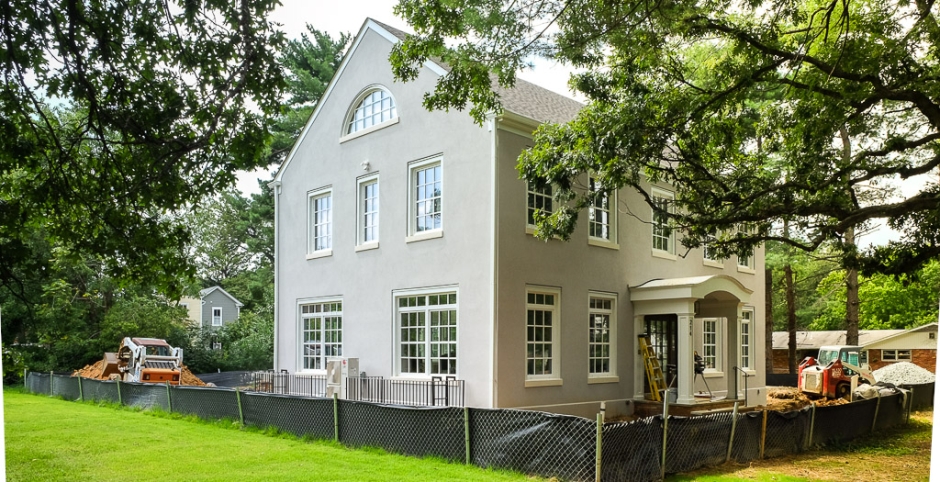
    L and Z came to us after learning about our first Passive House in Bethesda. They were moving to the area with their four young children and wanted a home that was as healthy and as environmentally benign as possible. While they liked the Bethesda house, they had different space needs and wanted a house that would fit better into their historic Rockville neighborhood. That generated an entirely different style and floor plan. Their new home is inspired by some of the early 20th century DC homes in neighborhoods like Old Rockville and Cleveland Park.
    We have set up a web page for the house and will be providing more photographs and information about the construction details and how we applied the lessons learned from our first Passive House.

  • Our New Website!

    With the help of Alissa Jones, a talented designer, we have just updated our website! In the coming months we will continue adding projects and images. Please take a look!