Category: Uncategorized

  • Earth Day 2020

    Earth Day 2020

    With the passing of an old classmate at noon and with another clinging to life tonight on a ventilator, I am particularly mindful on this Earth Day of life’s fragility, and of our tenuous place on this planet. How do you make sense of what is senseless? I am sad. I am angry. I am hopeful.

    The Covid-19 virus did not occur in a vacuum. It is but the latest manifestation of the imbalance in our relationship with the natural world. While no one can be certain how the virus began, it is likely the result of human settlement pressing further into wild habitats. Epidemiologists tell us that unless we change that basic condition these pandemics will be increasingly frequent and more lives will needlessly be lost.

    It is amazing how swiftly, effectively and selflessly the entire planet has acted in the face of this immediate crisis. We have shut down the world economy in order to protect our most vulnerable citizens.  While less immediate, climate change presents a far greater threat. And like the disease, it threatens the most vulnerable –in the case of climate change, the poor, and the unborn generations of children.

    It is incomprehensible to me that we can react so effectively to the one threat and fail so utterly to address the other – as nations, as political parties, and in our own lives. With every new manifestation of our imbalance with nature, even after fifty years of warnings from our scientists, we continue to repeat the same pattern. We muddle through, adapt to the new normal, and go back to our busy lives. And each new normal is more compromised than the one that preceded it, until eventually we forget what the old normal was.

    But something different is happening with this disease. Unlike a hurricane, or a killer heat wave, or a wave of climate refugees, nothing outdoors has been destroyed or disrupted. In fact, with no cars on the road, we can see the stars again. From our rear window we can see families spending time in their yards together again. We can see neighbor helping neighbor and communities really being communities. Paradoxically, in the midst of all the death and isolation, we are getting a tiny reminder of what the old normal was.

    Could this be what it takes for us to finally break the cycle of unplanned wrenchings of our lives and of the world economy, of continual new normals, and finally take charge of our fate? Imagine if we redirect all those resources lost in reaction to every new crisis and decide instead to put them into a planned approach to achieve carbon neutrality. Far from saving a few hundred thousand lives, we might save humanity itself, and in the process return to a proper relationship with the natural world. Covid has taught us that we can act, and act effectively in the face of a threat. All we need is the will to do it.
  • Carriage House Retrofit wins AIA DC Citation for Sustainable Design!

    Carriage House Retrofit wins AIA DC Citation for Sustainable Design!

    The DC  Chapter of the AIA held its annual awards jury this week, and our Stable Carriage House retrofit won a Citation for Sustainable Design. All of Izumi’s hard work managing a very difficult project paid off! Congratulations to the entire team. You can see who was on the team and check out the project here.

  • Arlington Zero Energy Passive progress: footings in place

    Arlington Zero Energy Passive progress: footings in place

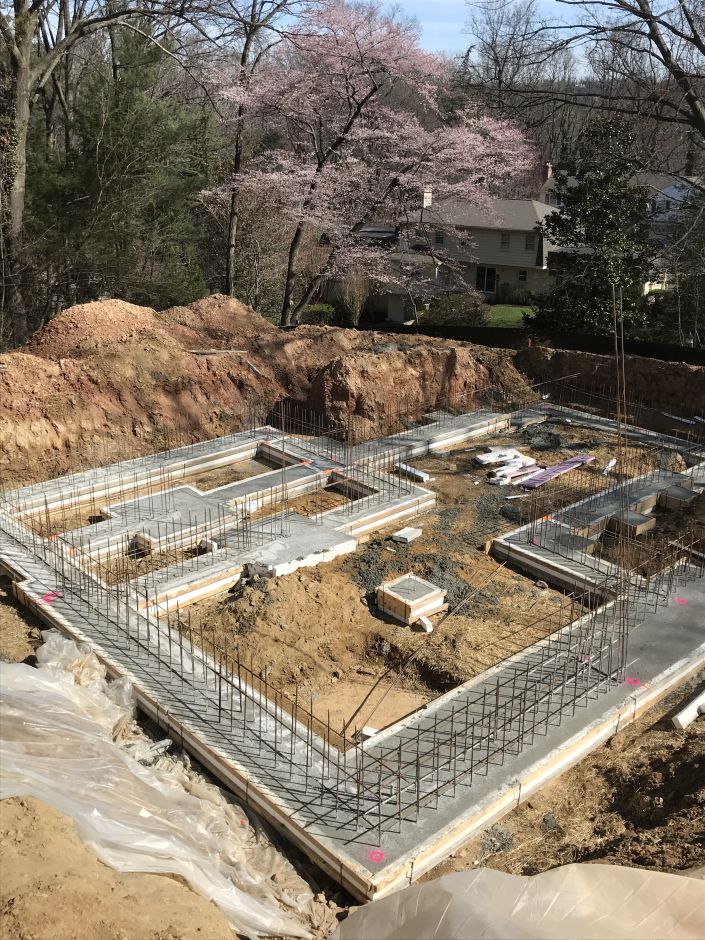
    After extensive excavation on a difficult site, the footings were poured this week, and as I write this post, the formwork for the basement walls is going up. What makes the site so difficult is the steep slope and the very little room onsite for equipment and storage of earth.

    The procedure for the footings is the same we have used for all our recent houses: 4” EPS insulation below and around sides of footings. As you can see from the photos, however, there is considerably more steel in this project, as the basement walls serve to retain two stories of earth on the uphill side.

    Below: EPS insulation at bottom and sides of formwork


    Reinforcing at footing under 2 story concrete wall:

    Concrete poured:

    In this photo, the 4″ x 4″EPS running across top of footing near the corner blocks out the space for the connection between interior and exterior footing drains:

    Looking toward the hillside:


  • DC Landmark Stable and Carriage House Deep Energy Retrofit Now Complete

    DC Landmark Stable and Carriage House Deep Energy Retrofit Now Complete

    Work is now complete on our DC Landmark carriage house deep energy retrofit. We have published pictures and a description of the project here.

  • Work begins on our  newest Net Zero home

    Work begins on our newest Net Zero home

    Site work has begun on our newest net zero home. The builder is O’Neill Development, with whom we have worked on all of our Passive Houses. The first step was to de-construct the original house, in which the owners had lived for the past twenty years. De-construction is being completed this weekend by Deconstruction Services, LLC.. Their first step was to glean all the usable equipment from the house — doors, cabinets, fixtures, etc — which they donated to ReBuild Warehouse. Then they tackled all finishes that could be removed intact and re-purposed, the hardwood flooring, and all the framing lumber. All nails are taken out  in their shop; the wood is stacked and graded; and then it is given to Community Forklift to go into other homes.

    The next step is for Bartley Concrete, the concrete subcontractors, to demolish the brick walls left standing and all the existing concrete. These materials will all then be put in a dumpster and taken to a commercial recycling facility for sorting. They will end up as rubble for roadbeds and the like. In our last project, less than 8% of the house went to a landfill.


    View from street after deconstruction, before demolition.

    View from below after deconstruction, before demolition.
    New Net Zero Home in Arlington VA
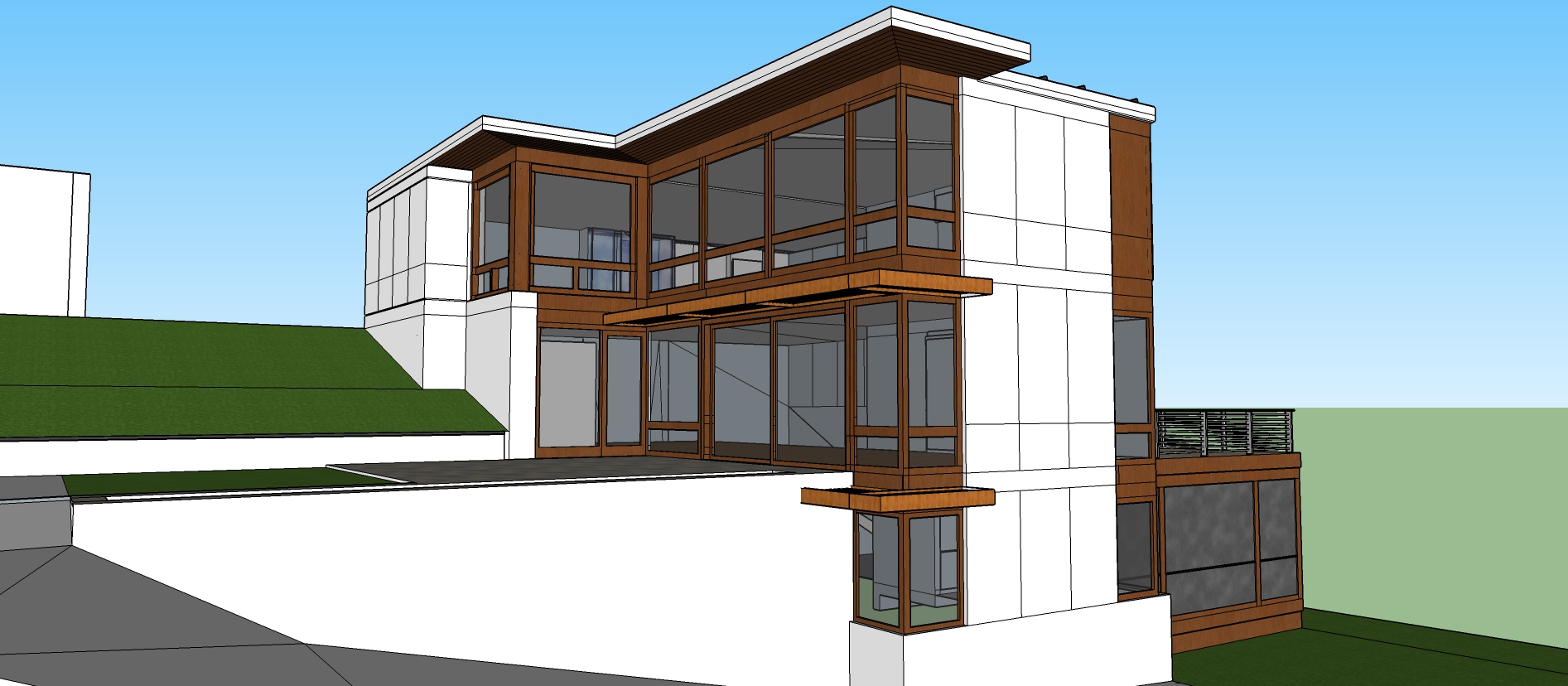
    Rendering of the final design
  • Report from our Maine Deep Energy Retrofit


    My family just spent two weeks of Christmas vacation in the 1850 SF farmhouse we renovated last year. You can learn more about the renovation on that blog. Here is how it performed with a family of 5 plus a couple of extras beds filled from time to time:

    Heating:

    We heated exclusively with the new Moreso 7642 woodstove in the first floor kitchen. That puts out a maximum heat of 35 kBtu/hr once it’s fully fired up. On cold days (mid teens) with no sun we kept the stove going all the time, and temperatures stayed in the high 60’s. Adding more logs we could have pushed it into the low seventies. When there was sun, regardless of the outdoor temperature, the front (south) rooms of the house got into the mid seventies and we let the stove die down till late afternoon.

    What was most satisfying though was the lack of drafts and the even temperatures throughout the house, never varying more than a couple of degrees between attic and first floor spaces. I think the reason has as much to do with the continuous insulation as with the Zehnder HRV which we kept running at low speed distributing the air.

    Electrical and solar

    We also kept track of electrical use to get a sense of the demand that we will need to fulfill with the solar and battery package that we will be installing in March. With a houseful using the old electric washer and dryer, the old radiant electric heater in the un-restored bathroom, and doing a good bit of cooking and baking on the induction cooktop and electric oven, we burned through nearly 35 kWh/day. That would require an array producing 12,700 kWh/yr to achieve NZE on an annual basis.  I logged one 24 hour period, however, where we did not use the radiant bathroom heater (which is temporary) and the washer and dryer. The energy use plummeted to 15.8 kWh/day, or an annual demand of 5,775 kWh/yr. So once we disconnect the old electric heater and set up winter clotheslines in the basement to supplement summer clotheslines, we will be well under the 8,400 kWh/year anticipated from the array.


    Batteries

    The EnSync Energy matrix will come with two 9kWh Li-Ion batteries for an effective storage capacity of 18kWh. This would give us one day of full use, but as the only really critical loads are the water pump, the furnace switch, and the refrigerator, we should easily be able to go without power for a week in the winter, cooking on the woodstove and playing by ear how much we use the induction stove.

  • A proposed microgrid community of modular net zero homes

    This YouTube video is a presentation we just did for a community development group in Virginia interested in developing a new neighborhood of high performance net zero energy homes. Our concept is based upon using a combination of several basic modular designs to create both single family homes and duplexes. We show them with both contemporary and traditional appearances.

    The construction approach is based upon the prototype modular Passive House we completed with Housing Initiatives Partnership in 2015.

    The video begins moving down the existing street, which has existing concrete affordable housing units on the right as you drive down it. We make a U-turn at the end of the street and begin back up the sidewalk, passing two existing modern houses sandwiched in with our new single family modular homes. We then go down the new street, passing a mixture of contemporary and traditional modular duplexes. Coming back up that street we pass the day care/ training center, proposed as a cross-laminated timber structure, and then duck down the back alley to see the community garden and solar array for the community microgrid in the background.


  • The Microbiome and Your Home

    I have been reading recently of developments in the study of the human microbiome and its interconnection with the larger environment.  It is changing my thinking about how we should be building our houses (and hospitals!). A microbiome is basically the collection of organisms that inhabit a particular environment, be that the intestine or a field of daisies. It turns out that that the interaction between different microbiomes is far more dynamic that we ever imagined. It confirms scientifically that it is an illusion that we are separate from the environment in which we live; it is part of us and we are part of it.

    For the last fifty years we have seen bacteria and viruses (billions of which make up the microbiome) as the enemy, and we have been at war with them on every front – at the macro scale with millions of tons/year of glyphosphate (Roundup, for example, which is actually patented as an antibiotic not a pesticide) dumped into the environment, and at the micro scale with antibiotics pumped into livestock and humans at alarmingly increasing rates.  We have been killing life wherever we meet it. We are now learning that the chronic health issues we face today, particularly autoimmune diseases, are all collateral damage of that war. We are learning that we co-inhabit the world with these organisms and they are essential to our own life.

    So what does this mean for our homes? The evidence is overwhelming that buildings that get poor fresh air ventilation of can be toxic. Legionnaire’s disease and Sick Building Syndrome are life-threatening. The energy recovery ventilation systems that we provide in all our houses address this issue; even though these houses are airtight, they have plenty of fresh air at all times. Similarly, our approach to building envelope design eliminates condensation and takes away the issue of toxic mold growth getting into the building microbiome.

    But is this enough? We know plenty about what makes an unhealthy building microbiome, but so little about what makes a healthy one. Do the MIRV13 filters in our ERV’s take out too much from our fresh air, for example? One study shows that exposure to dog-associated bacteria can be protective against airway allergens. Another shows that the more diverse the microbial environment, the lower the incidence of asthma. And here is a creepy one:

    “children exposed to specific types of bacteria… in common with well known allergens at high levels had a reduced risk of allergic disease”..and “mice and cockroaches were the sources of these bacteria associated with a beneficial health outcome.”

    These studies come from a paper called Ten Questions Concerning the Microbiomes of Buildings, and I recommend it if you want to really get into the weeds on this.

    Another study, by Zach Bush, MD, examines what glyphosphates do at the human cell level, particularly regarding the gut lining, and tracks the growth of a number of chronic diseases with the parallel growth in the use of this pesticide throughout the world. Truly frightening to learn that this chemical is in the water cycle of over 60% of the planet — you get it whether you buy organic or not.

    It is a paradigm shift for me to learn just how illusory is the line between us and our environment. The study is just beginning and we have a lot to learn. Our takeaway for now is:

    • Continue to provide continuous fresh air
    • Continue to design a condensation-free building envelope
    • Provide as much vegetation as possible around the home and particularly around the air intake for the energy recovery ventilation system (this does not include a green lawn maintained by weed killers and chemical fertilizers!)
    • Don’t use anti-bacterial cleaning products in the home
    • Get outside and get dirty in the garden as much as possible for a more diverse and healthy microbiome in your own body
    • Get on the floor and love your dog!
    • We stop short of inviting in mice and cockroaches.
  • Recent speaking engagements

    It has been a long time since our last post and I’ll start with an update of some speaking engagements, as we have continued over the last year to get out the word on high performance building design.

    In June, Matt and David both gave presentations at the Arlington Initiative to Rethink Energy workshop On a Path to Zero Energy Construction. We were joined in that by Katrin Klingenberg, Director of PHIUS, and other Passive House practitioners.

    In October Matt was the keynote speaker at the AIA’s Blue Ridge Chapter at their fall educational event in Roanoke, speaking on the subject of affordable high performance housing. The event was organized by Greg Tew, Associate Professor at Virginia Tech School of Architecture.

    Then in January Matt, Izumi and David did a day-long HalfMoon Education seminar for architects and builders on Passive House planning and design. This was the second time we’ve done this program, and this time we brought in Dave Geary of EnSync Energy and DC Fusion to address the natural fit between high performance buildings and hybrid dc microgrids as a path to zero energy buildings.

    In March David sat on an AIA panel discussion on high performance houses organized by Mike Binder, President of the AIA DC Chapter’s Committee on the Environment.

    And most recently, earlier this month David sat on a panel at a symposium put on by the Belgian Embassy and the World Resources Institute on the adoption of Passive House in the US and Europe.

    Matt and Izumi and I all welcome these opportunities to further knowledge about energy efficiency in buildings. Please contact us if you have a group that is interested in learning more on this subject.

  • Work underway on Landmark DC Carriage House Deep Energy Retrofit

    Construction is underway on our first deep energy retrofit of a historic structure.  The Spencer Carriage House, listed as a DC Landmark and on the National Register of Historic Places, was built in 1905 to serve one of the large mansions in the Dupont Circle area. It is one of the last of these carriage houses remaining, only a 3 minute walk to Dupont Circle. In its original configuration stables and carriages were housed below, with servants’ quarters above.  Over the last hundred years the building has been used as a garage, as a car dealership, as a tony restaurant and as a bar. Our clients are turning it into a home, and what they hope to be the first Passive House certified historic retrofit in the country.

    (Restaurant in 1960)
    (Restaurant in 1960)
    (Exterior of building)
    (Exterior of building)


    When they purchased the building, it was abandoned and essentially nothing of the original interiors remained. The exterior, however, with its 14” masonry walls, was in very good shape though the slate roof had outlived its useful life. Because it is a historic structure, all of our retrofit work must be done on the interior. Essentially we are constructing a building within a building.

    Here is a rundown of the key features:

    SIZE:                     5,700 SF  ~  4 Bedrooms; 4 Baths and 2 Half baths
    FOOTINGS:         Existing
    SLAB:                   4” concrete with 4” EPS below (R20)
    WALLS:               Existing 14” masonry  with liquid air water barrier applied to inside face + 2” EPS + 9-1/4”
    double stud wall with densepack fiberglass + Intello at interior face (R40)
    ROOF:                  9 1/2” TJI’s with densepack fiberglass + 2” EPS above and 1” EPS below (R52)
    WINDOWS:         Zola wood triple glazed (R6)
    AIRTIGHT LAYER: Inside face of masonry
    MECHANCAL:    Mitsubishi City-Multi with ducted and cassette air handlers, Zehnder ERV
    HOT WATER:      Solar with electric back-up
    AIRTIGHTNESS: TBD

    The first step was demolition of the accretions of 100 years of various occupants.

    (Before interior)
    (Before interior)

    2-IMG_3969


    With regard to the existing floor slab and footings, we were able to remove the first but hardly the second! Our approach is to take up the existing concrete, which was badly cracked, settled and sloped, and replace it with a new insulated floor slab. The insulation we are providing at the interior face of the historic masonry walls will continue down and tie into the new under-slab insulation, thus thermally isolating the existing footings. The only un-isolated footings will be the interior footings under existing posts and columns.

    The existing concrete slabs have now been removed, ground insulation installed, and rough slabs poured. Here are some images of that work:

    (Before pouring base slab showing rebars over stego wrap over 4” EPS, After pouring 4” base slab)
    (Before pouring base slab showing rebars over stego wrap over 4” EPS, After pouring 4” base slab)

    3-IMG_5011


    With all retrofits, the biggest challenge is dealing with thermal bridges. In this case the issues were the existing floor joists’ connection to the exterior masonry and the places where the walls and columns meet the ground.

    (Prosoco Joint and Seam Filler around each existing joist)
    (Prosoco Joint and Seam Filler around each existing joist)

    We originally planned to cut off all existing floor joists at the wall, fill the joist cavities, and build a new exterior bearing wall that was connected to the interior face of the exterior masonry wall but completely isolated thermally. The extra thousands of dollars required for temporary shoring of the existing masonry walls made this approach prohibitive. Instead, we have amended this approach, leaving most of the existing joists in place, then encapsulating them in foam at the first 12” away from the wall. The foam encapsulation will prevent any potential condensation on those surfaces in winter.


    The interior face of exterior walls have been cleaned and scraped, and Prosoco’s vapor permeable CAT5 air water barrier system applied. This wall surface will be the air barrier for the building and the CAT5 will lap over the under-slab vapor barrier. Here are some photos of that work.

    (Prosoco adhesive test)
    (Prosoco adhesive test)
    (CAT5 laps over stego wrap)
    (CAT5 laps over stego wrap)


    (2x6 LSL studs over 2” EPS board attached to Prosoco applied inside masonry walls)
    (2×6 LSL studs over 2” EPS board attached to Prosoco applied inside masonry walls)

    6-IMG_3788


    (Exterior walls have been cleaned and repaired/repointed damaged brick)
    (Exterior walls have been cleaned and repaired/repointed damaged brick)

    7-IMG_5610


    Because of the poor condition of the existing roof and under-designed existing roof rafters, we are replacing the existing roof entirely and taking that opportunity to rebuild a passive house level roof assembly. The existing roof lumber will be reused for cabinetry and furniture.

    (Existing rafter and cupola)
    (Existing rafter and cupola)

    8-IMG_6206


    (Steel posts/beams for elevator shaft)
    (Steel posts/beams for elevator shaft)
    (Steel posts/beams for opening to garage additions)
    (Steel posts/beams for opening to garage additions)


    (steel hip beams have been installed)
    (steel hip beams have been installed)

    9-IMG_7006


    New TJI roof framing and roof decking were installed. Prosoco Joint and Seam Filler were applied at all joints for continuous air/water membrane.

    10-IMG_8751 10-IMG_8773


    (The Zola windows have been installed)
    Zola windows now installed. Brickmold not yet applied, which will hide low expansion foam which fills voids. Windows are taped at the inside face of the frames.

    11-IMG_8772


    (Electrical, plumbing, HVAC works are in progress)
    Electrical, plumbing, HVAC work is in progress.


    Next steps are the first blower door test, then cavity insulation installation.